What Is Double-Wall Vacuum Insulation?
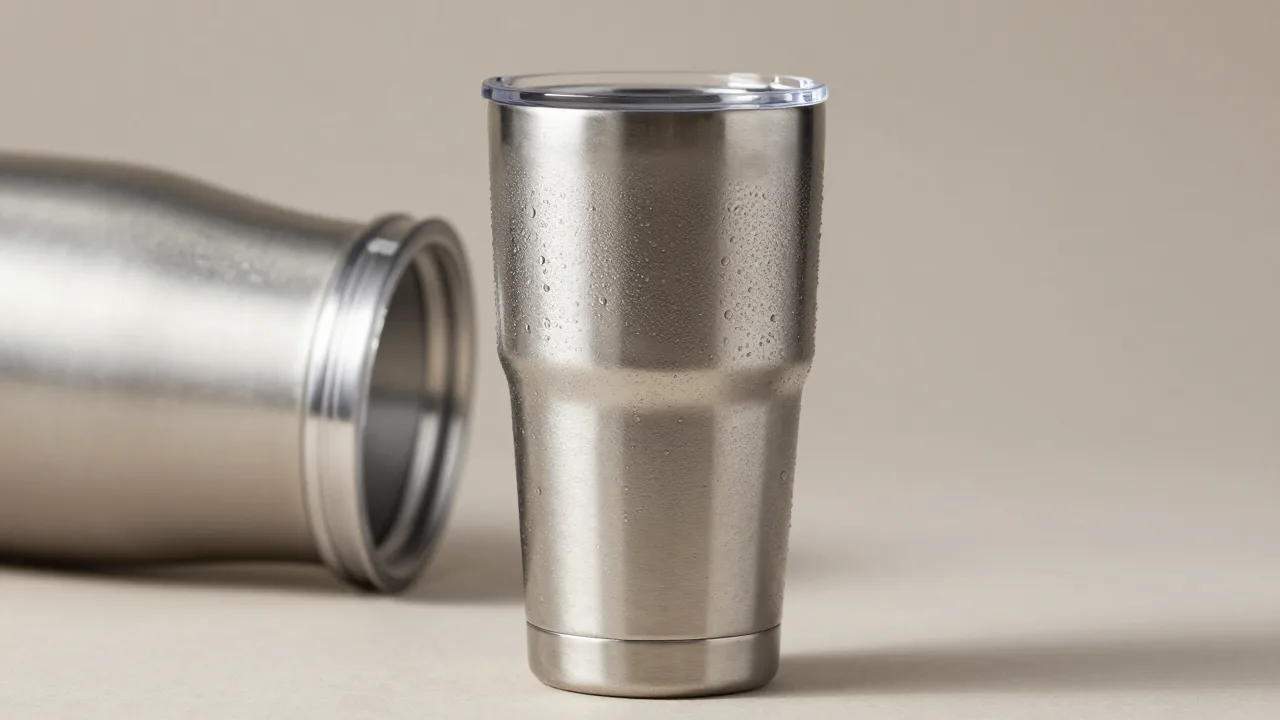
Pick up a decent stainless tumbler full of ice water on a humid afternoon and something strange happens: nothing. No sweat, no ring on the table, no cold shock in your palm. The cup feels like it is holding room-temperature air. Meanwhile the same water in a glass would have soaked a coaster in four minutes. That gap between expectation and reality has a name, and it is the single most important piece of technology in modern drinkware.
The phrase gets printed on every product page — double-wall vacuum insulated — and almost nobody reads it closely enough to notice that it is really two claims stacked together. One of them is easy to fake. The other is expensive, and it is the one that does all the work. Here is what is actually happening inside the wall of your cup.
The Short Definition
A double-wall vacuum-insulated container is made of two separate stainless steel vessels, one nested inside the other and welded together at the rim. Before the final weld is sealed, a pump evacuates the air from the space between them, and a small port at the base is closed off. What remains in that gap is not thin air — it is a near-vacuum, typically well below one-thousandth of normal atmospheric pressure. That emptiness is the insulation.
The concept is not new. Scottish physicist Sir James Dewar built the first vacuum flask in 1892 to hold liquefied gases in his laboratory, and the design was commercialized as the Thermos a decade later. Everything on the shelf today — the tumbler, the travel mug, the growler, the food jar — is a refinement of that same 130-year-old idea, executed in stainless steel instead of silvered glass.
Heat Has Three Ways Out. The Vacuum Blocks Two of Them.
To understand why the vacuum matters so much, it helps to know how a hot drink loses heat in the first place. There are exactly three mechanisms, and a good cup has to deal with each one differently.
- Conduction. Heat moves directly through touching material. In a ceramic mug, warmth conducts straight through the wall and into your hand and the air. Conduction needs matter to travel through — remove the matter and it stops.
- Convection. Heated air or liquid physically moves, carrying energy with it. Air trapped in an ordinary double-wall gap sets up a slow circulating current: warmed at the inner wall, cooled at the outer wall, around and around. Remove the air and there is nothing left to circulate.
- Radiation. Every warm object beams infrared energy outward, and radiation crosses empty space perfectly well. This is the one a vacuum cannot stop, which is why the next section exists.
Here is the part that surprises people: pulling the vacuum eliminates roughly 90 percent of the heat transfer in one manufacturing step. Conduction and convection are the big leaks, and both of them require a medium. Take the medium away and the drink is left sitting in a thermal island, connected to the outside world only through the thin metal rim where the two walls meet and through radiation across the gap.
The Silver Trick: Beating Radiation
Premium vacuum flasks add one more layer of defense that almost never gets advertised. The outward-facing surface of the inner wall is coated with a microscopically thin reflective film — historically silver, now usually copper or aluminum applied by vapor deposition. A polished metallic surface is a poor emitter of infrared radiation, so instead of beaming heat across the vacuum gap, the inner wall reflects it back into the drink.
This is why you sometimes see "copper-lined" or "copper plated interior wall" in the specifications of higher-end bottles, and why those bottles genuinely outperform bargain ones with identical wall thickness. The vacuum handles conduction and convection; the reflective coating handles radiation. Together they close all three doors. A bottle with the vacuum but no coating still works well — it just gives up several hours of retention on a long day.
Anatomy of a Vacuum Tumbler
Flip a stainless tumbler over and you can read most of its construction story from the outside:
- The inner vessel holds the liquid. Look for 18/8 (also written 304) food-grade stainless steel, meaning 18 percent chromium and 8 percent nickel. That alloy resists corrosion from coffee acids, citrus, and salt without imparting flavor.
- The outer shell takes the abuse, the powder coating, and the branding. It never touches your drink.
- The rim weld is where the two walls join, and it is the only continuous metal path between inside and outside. It is why the lip of a vacuum tumbler feels warm on a hot day and why heat escapes fastest at the top.
- The vacuum port is the small plug or dimple in the base, sealed after evacuation. On many models it is hidden under a rubber foot. This is the most common point of failure.
- The getter is a tiny patch of reactive material inside the gap on well-engineered bottles. It absorbs stray gas molecules that outgas from the steel over the years, preserving the vacuum long after manufacturing.
Ice Test: A $12 Tumbler vs. a $38 Tumbler
Illustrative scenario — a composite example built to show how the numbers work. It does not describe a real business or customer.
We filled two 20-ounce tumblers to the brim with 12 ounces of water and 8 ounces of ice, sealed both lids, and left them on a kitchen counter at 74°F. The $38 vacuum-insulated model with a copper-coated inner wall still had visible ice at the 26-hour mark and the outside was bone dry the entire time. The $12 tumbler — labeled "double wall insulated," with no mention of vacuum anywhere in the listing — lost its last ice cube at 6 hours and developed light condensation around the base by hour two. That condensation was the giveaway: a true vacuum wall cannot sweat, because its outer surface never gets cold enough to hit the dew point. If your insulated cup leaves a ring on the table, the gap has air in it. That single observation is a more reliable test than any spec sheet.
Double-Wall Does Not Automatically Mean Vacuum
This is where most shoppers get separated from their money. Three very different products all wear the "double-wall" label:
| Construction | What's in the gap | Hot retention | Cold retention | Sweats? | Typical use |
|---|---|---|---|---|---|
| Double-wall vacuum stainless | Near-vacuum | 5–7 hours | 20–30 hours | No | Tumblers, bottles, travel mugs |
| Double-wall stainless, air gap | Trapped air | 1–2 hours | 4–6 hours | Sometimes | Budget tumblers, party cups |
| Double-wall borosilicate glass | Trapped air | ~1 hour | 2–3 hours | Rarely | Espresso, latte, tea service |
| Double-wall plastic | Trapped air | Under 1 hour | 2–4 hours | No | Cold cups, kids' cups |
| Single-wall stainless | Nothing — one wall | Minutes | Under 1 hour | Heavily | Camp cups, bar shakers |
Notice that only the first row involves an evacuated gap. Double-wall glass is a genuinely lovely product for a different reason — it keeps the outside cool enough to hold and makes an espresso look like it is floating — and we cover that trade-off in our guide to double-wall glass cups. But no glass cup will hold coffee hot through a commute. If the marketing copy never uses the word vacuum, the manufacturer almost certainly did not pay for the vacuum step.
What the Numbers Actually Mean
Manufacturer claims like "hot 12 hours, cold 24 hours" are measured under laboratory conditions that bear little resemblance to a Tuesday. Those tests use a full fill, a sealed lid never opened, a controlled 68 to 72°F room, and a generous definition of "hot" — often anything above 120°F, which is lukewarm coffee by most people's standards.
Realistic expectations for a quality 20-ounce vacuum tumbler look more like this: coffee poured at 175°F sits around 150°F after two hours, drops through 140°F near the four-hour mark, and reaches genuinely disappointing territory somewhere between five and seven hours. Ice water lasts 20 to 30 hours indoors and roughly half that in a hot car. Three variables move those numbers more than brand does:
- Fill level. A half-full bottle has a large volume of headspace air that must be heated or cooled along with the liquid, and it loses temperature nearly twice as fast. Fill it up.
- Preheating or prechilling. Rinsing the interior with boiling water for 60 seconds before filling — or with ice water before a cold fill — eliminates the energy the steel steals from your drink in the first ten minutes. This single habit is worth an extra hour or more.
- Lid discipline. Every opening dumps the warm or cold headspace and replaces it with room air. A flip-lid opened twenty times on a job site loses far more heat than one opened three times.
None of this is unique to consumer cups, incidentally. Cafés that run large iced programs think about the same physics on a bigger scale, since holding product at temperature and moving it fast are the two levers behind how drink shops shave seconds off every order during a morning rush. On the commercial side, holding temperature stops being a comfort question and becomes a margin question — the same calculation that shapes the economics of a cold brew and nitro program, where every degree of drift costs yield.
How Vacuum Cups Fail
A vacuum wall is a permanent state, right up until it is not. Failures are rare but total — there is no partial vacuum performance, just a cup that suddenly acts like a thin metal container. Watch for these:
- Seal breach at the base. Dropping a tumbler squarely on its bottom corner can crack the evacuation plug. Air seeps in over hours or days and the cup quietly stops working.
- Deep dents that bridge the walls. A cosmetic ding is harmless. A dent deep enough to press the outer wall against the inner wall creates a direct conduction path, and heat pours straight through that contact point.
- Sudden sweating. The clearest field diagnostic there is. If a tumbler that never condensed starts leaving rings on your desk, the vacuum is gone.
- Gasket fatigue. Not a vacuum failure, but often mistaken for one. A hardened, cracked lid gasket lets steam escape and can cost hours of retention. Most manufacturers sell replacements for a few dollars.
Once a vacuum is lost it cannot be restored outside a factory. That is why reputable brands back their bottles with long warranties — the failure mode is binary and easy to verify. Before you assume yours is dead, though, check the lid seal and run the temperature test with a full fill, since routine cleaning and maintenance habits account for more perceived performance loss than actual vacuum failure.
Buying Advice, Condensed
- Demand the word "vacuum." Not "double wall," not "thermal," not "insulated." Vacuum.
- Look for 18/8 or 304 stainless on the interior. Avoid unspecified "stainless steel" on cheap imports.
- Copper or reflective inner coating is a real differentiator on bottles you carry all day.
- Match capacity to habit. A 40-ounce tumbler you fill halfway performs worse than a 20-ounce you fill to the top.
- Prioritize the lid. Most heat escapes through the opening. A gasketed screw lid beats a friction-fit slider by a wide margin, and a straw lid is the weakest of all for hot drinks.
- Buy a warranty, not a logo. Because vacuum failure is binary, a lifetime or ten-year warranty is a meaningful signal of manufacturing confidence.
If you are comparing specific models rather than construction types, our travel tumbler comparison puts the popular sizes side by side, and the deeper physics is laid out in how thermos technology works.
The Bottom Line
Double-wall vacuum insulation is one of the few consumer technologies where the marketing understates the science. Two steel walls, the air pulled out from between them, a reflective film to bounce back infrared — that is the whole design, and it shuts down all three routes heat uses to escape. The result is a cup that ignores the weather: your coffee stays drinkable through a long morning, your ice survives a full workday, and your desk stays dry. Just read the label carefully, because "double-wall" alone buys you a hollow cup, and the vacuum is the part worth paying for.
Keep Comparing Drinkware
Use the iCup library to compare materials, lids, cleaning routines, heat retention, glass shapes, and daily-use tradeoffs before buying another cup.
Explore More iCup Guides →