Compostable vs Recyclable To-Go Cups
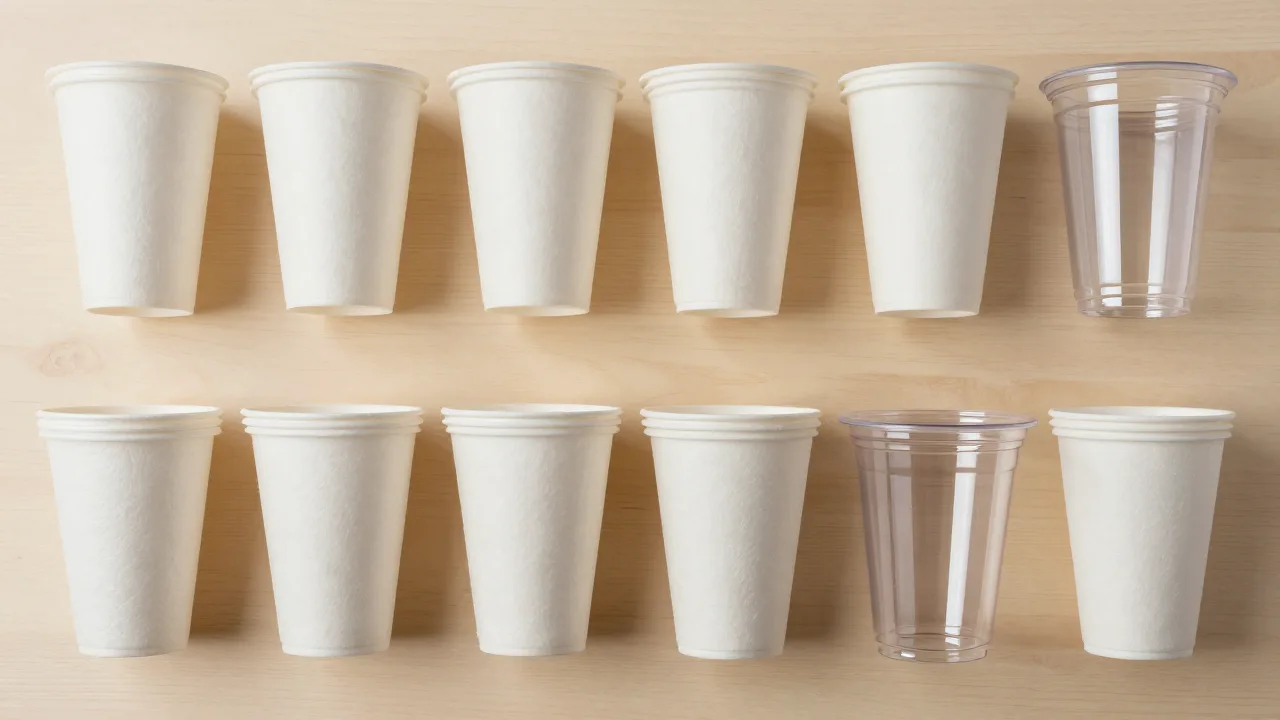
You switched to compostable cups. You paid nearly double per unit, put a little leaf logo on the sleeve, and told customers the cup goes back to the earth. Then one afternoon you followed the bin out to the curb and watched it get tipped into the same truck as everything else, bound for the same landfill, where a corn-plastic cup will sit essentially intact for decades because a landfill has none of the heat or oxygen it needs.
That is the part nobody puts on the packaging. A compostable cup is not compost — it is a cup that can compost under industrial conditions that, by most counts, only a couple hundred facilities in the entire United States provide for food-service packaging. A recyclable cup is not recycled either, not usually. Poly-lined paper is rejected at most sorting lines, and clear plastic cups get pulled out of the stream when they arrive sticky with sugar and pearls. Both labels describe a possibility. Neither describes an outcome.
So the useful question is not which material is greener in the abstract. It is a much more local, much more boring question: what does your hauler actually take? Answer that first and the rest of this decision gets simple. Let's work through it.
What "Compostable" Actually Means
In North America the word carries a specific technical meaning backed by ASTM standards — D6400 for plastics, D6868 for coated paper. To earn certification from an organization like BPI, a cup must disintegrate and biodegrade in a commercial composting environment within roughly 84 to 180 days, leaving no toxic residue and no visible fragments above a set size threshold.
Read that carefully: commercial composting environment. That means sustained internal temperatures near 140°F, managed moisture, regular turning, and a microbial population that a backyard bin almost never achieves. The two common compostable cup materials behave very differently:
- PLA-lined paper and clear PLA cups. Polylactic acid is a bioplastic made from fermented plant sugar, usually corn. It is genuinely certified compostable, and genuinely inert in a landfill or a home pile. It also softens around 110°F, which is why PLA is used for cold cups and PLA-lined paper for hot ones, but never for a clear hot cup.
- Uncoated molded fiber and bare paper. Bagasse — sugarcane pulp left over from sugar production — plus bamboo and unbleached kraft. These break down in almost any active compost, including a home pile, because there is no plastic layer to survive. They are also the only "compostable" cups that behave the way customers assume all of them do.
Then there is a third category that muddies everything: cups labeled "biodegradable," "plant-based," or "eco" with no certification mark at all. Those words are essentially unregulated marketing. Several states now restrict their use precisely because they mean nothing verifiable. If a cup does not carry a BPI number or an ASTM reference, treat the claim as decoration.
What "Recyclable" Actually Means
Recyclability is a supply-chain fact, not a material property. A cup is recyclable when a nearby facility accepts that resin, a mill wants the bale, and the item arrives clean enough to process. Break any link and the label is aspirational.
Here is how each common to-go cup fares in a real materials recovery facility:
- Poly-lined paper hot cups are paperboard bonded to a thin polyethylene film. Standard mills pulp paper in water, and that film does not disperse — it clogs screens and taints the batch. Only a limited number of mills have installed equipment to separate it, so most sorting lines route these cups to landfill regardless of what the bin says.
- Clear PET cold cups (resin #1) are the best-case scenario. PET has real market value and an established recycling stream. The catch is contamination: residual smoothie, syrup, or milk foam gets a cup pulled at the line.
- Polypropylene cups and lids (resin #5) are accepted in a growing number of programs but far from all of them. Small items like lids frequently fall through screens designed for larger material and end up as residue.
- Polystyrene foam (resin #6) is functionally unrecyclable in curbside systems and banned outright in a growing list of cities and states.
- Double-wall and ripple-wrap hot cups combine paperboard, adhesive, and lining. More layers, more separation steps, lower odds.
There is a promising middle path worth watching: paper cups coated with water-based dispersion barriers instead of polyethylene. These are engineered to repulp in a conventional mill. Adoption is still early and pricing is above conventional stock, but if you are locking in a multi-year packaging contract, ask your supplier where they stand on it.
Side by Side
| Cup type | Material | Real end-of-life | Needs | Rough cost, 12 oz |
|---|---|---|---|---|
| Poly-lined paper hot cup | Paperboard + PE film | Landfill in most regions | Specialty mill | $0.06–$0.09 |
| PLA-lined paper hot cup | Paperboard + PLA | Compost, if a facility exists | Industrial composting | $0.11–$0.16 |
| Clear PET cold cup | PET (#1) | Genuinely recycled if clean | Plastics stream + rinsing | $0.08–$0.12 |
| Clear PLA cold cup | PLA (#7) | Compost, if a facility exists | Industrial composting | $0.13–$0.18 |
| Molded fiber / bagasse | Sugarcane pulp | Composts, even at home | Any active compost | $0.10–$0.15 |
| Reusable ceramic or steel | Ceramic / 18/8 steel | Reused for years | Dishwashing capacity | One-time |
Costs are wholesale ranges at case volume and swing with region and contract, but the shape of the table holds: compostable stock runs 40 to 90 percent more per unit than its conventional equivalent, and it only earns that premium if the cup reaches a composter.
The Sorting Problem Nobody Warns You About
Here is where good intentions do measurable damage. A clear PLA cup and a clear PET cup look identical to a customer, and nearly identical on a fast-moving sorting belt. When PLA slips into a bale of PET, it melts at a different temperature and can degrade the whole batch. Recyclers consider bioplastic a genuine contaminant, not a bonus.
The same problem runs in reverse at composting facilities. Operators report that the biggest reason they refuse food-service packaging is not the certified material — it is everything that arrives with it: conventional plastic lids, straws, foil-lined wrappers, and uncertified look-alike cups. A load with too much plastic contamination gets rejected wholesale, and the whole batch goes to landfill anyway.
Which leads to a rule that sounds cynical and is actually just practical: a mixed program is usually worse than a committed one. Offering compostable cups with conventional lids, or recyclable cups next to compostable ones with no signage, produces two contaminated streams instead of one clean one. Pick a lane, label it plainly, and match every component — cup, lid, straw, sleeve — to that lane.
Field Audit: A 40-Seat Café That Switched Twice
Illustrative scenario — a composite example built to show how the numbers work. It does not describe a real business or customer.
A neighborhood café serving roughly 240 drinks a day moved from conventional poly-lined cups to certified compostable stock, raising packaging cost by about $0.06 per drink — roughly $14 a day, or $5,100 a year. Six months in, the owner called the waste hauler and learned the truth: the city's organics program accepted food scraps but explicitly excluded compostable serviceware, so every cup was going to landfill. The switch had bought a logo and nothing else.
The second move was smarter and cheaper. They kept clear PET for cold drinks, because the region has a functioning plastics stream, and put a rinse station beside the bin so cups arrived clean. For hot drinks they went the other direction entirely: a $2 discount card for anyone bringing a personal tumbler, funded by the savings from dropping compostable hot cups. Within four months, 31 percent of hot drinks went into customer-owned cups. Net packaging spend fell below the original baseline, and the sustainability story got more honest — they could point to a real number instead of a claim about a cup's theoretical fate.
A Five-Step Decision Framework
- Call your hauler and ask two specific questions. Do you collect commercial organics, and does that program accept certified compostable food-service packaging? A yes to the first and no to the second is the most common answer, and it settles the decision immediately.
- Search for a nearby composter that takes packaging. If your hauler says no, a regional facility may still accept a direct drop-off or contract a separate route. This is the single fact that makes or breaks a compostable program.
- Split hot and cold. They rarely have the same answer. Clear PET cold cups often have a real recycling path where hot cups have none, so running PET cold and reusables or compostable hot is a perfectly rational combination.
- Match every component. A compostable cup with a conventional PP lid contaminates the compost. A PET cup with a PLA lid contaminates the plastic bale. Order lids and straws from the same lane as the cup.
- Measure the thing you can actually control. Reuse rate. Track what percentage of drinks leave in a customer's own vessel, and treat that number as your real sustainability metric — it is the only one that does not depend on infrastructure you do not own.
If you run the numbers as a broader packaging decision, compare the cup system rather than the label. Waste stream access, storage space, lid compatibility, guest behavior, washing labor, and local disposal rules decide whether compostable, recyclable, or reusable service is honest.
The Option That Beats Both
Every single-use cup, however it is labeled, consumes material and energy to exist for eleven minutes. The math that actually favors the environment is reuse, and the crossover point comes faster than people expect: a stainless tumbler typically breaks even against single-use cups somewhere between 20 and 100 uses depending on how you count manufacturing energy and dishwashing. For a daily coffee drinker, that is a few months.
The reason reuse programs stall is almost never the cup — it is the dish pit and the friction at the counter. Customers forget their tumbler; staff worry about handling personal vessels; nobody wants to slow the line. All three are solvable with a discount that makes remembering worth it, a clear handoff policy, and a fast rinse. If you are choosing durable cups for a café or for yourself, our breakdown of eco-friendly reusable cups compares the practical options, and glass versus ceramic versus stainless covers which material survives real daily use.
One caution: a reusable cup only stays a good deal if it stays in service. Cups get abandoned because they smell, stain, or grow a film nobody wants to deal with — all avoidable with the routines in our guide to cleaning reusable cups properly. And if you want a material that handles heat and acid without holding odor at all, borosilicate glass is the quiet favorite among people who actually keep their cups for years.
The Bottom Line
Compostable and recyclable are not grades on a report card. They are conditional promises, and the condition is infrastructure you probably do not control. A compostable cup in a town without industrial composting is an expensive landfill item with a nice logo. A recyclable cup covered in smoothie residue gets pulled at the belt. Make the boring phone call to your hauler, choose the lane your region actually processes, match your lids to your cups, and put your real energy into the reuse rate — because that is the one number that works no matter what the truck does with the bin.
Keep Comparing Drinkware
Use the iCup library to compare materials, lids, cleaning routines, heat retention, glass shapes, and daily-use tradeoffs before buying another cup.
Explore More iCup Guides →