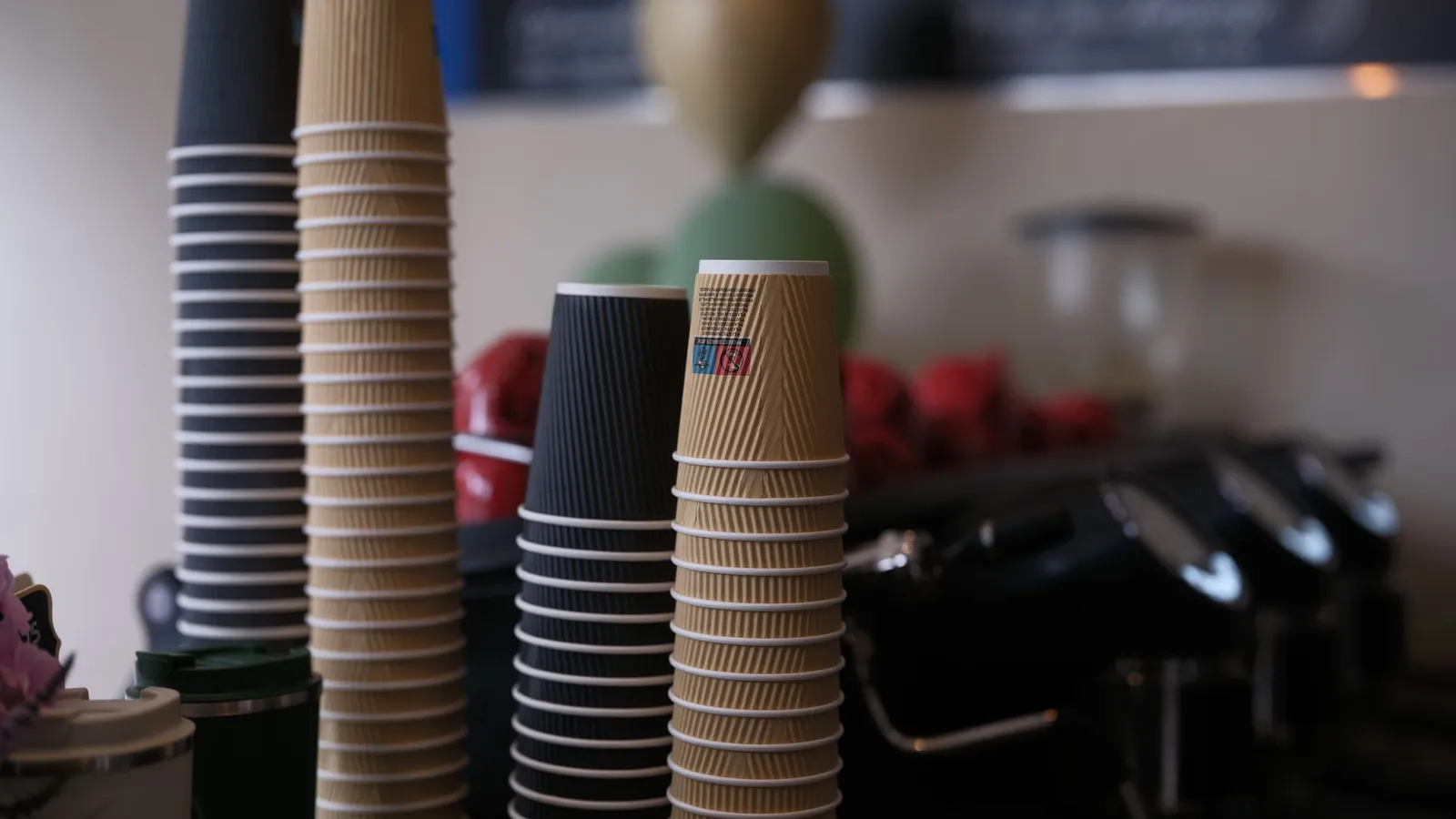
Recyclable cups in California: the SB 343 label check
California's "truth in recycling" law, SB 343, reached its compliance date on October 4, 2026. Under the law, products and packaging manufactured after that date are not supposed to carry the chasing arrows symbol, or any other recyclability claim, unless they meet the state's criteria. That includes the paper hot cups, clear cold cups and lids that cafes hand across the counter every day. There is a catch, though: a federal judge has blocked the Attorney General from enforcing the law while a lawsuit plays out. This guide covers what that means for a cafe or restaurant buying cups, and gives you a short method to check your own cup line.
What happened, with dates
- April 4, 2025: CalRecycle published the SB 343 Material Characterization Study Final Findings. That started an 18-month grace period.
- March 2026: A coalition of food, packaging and retail trade associations sued in federal court (California League of Food Producers v. Bonta, No. 3:26-cv-01675, S.D. Cal.), according to Resource Recycling. The groups argue the law's limits on recyclability claims violate the First and Fourteenth Amendments.
- June 24, 2026: CalRecycle published its most recent update to Table 2, the list of which material types California sorting facilities actually sort for recycling.
- July 14, 2026: U.S. District Judge William Q. Hayes granted a preliminary injunction. Attorney General Rob Bonta is "enjoined from enforcing SB 343 until further order of the Court," Packaging Dive reported. The ruling is preliminary and is not a final decision on whether the law is constitutional.
- September 28, 2026: The court denied a request by Californians Against Waste and Earth Island Institute to join the case in defense of the law, finding the Attorney General adequately represents that interest, Keller and Heckman reports. The groups may file amicus briefs, and an early neutral evaluation conference was set for November 4, 2026.
- September 29, 2026: CalRecycle held a workshop on the scope of its next characterization study. The study has to be redone in 2027 and every five years after that. CalRecycle says the injunction "only blocks enforcement of SB 343" and does not change that schedule.
- October 4, 2026: The grace period ended. CalRecycle still notes that this deadline "may be impacted by ongoing litigation."
The two sides see the law very differently. Julie Landry of the American Forest & Paper Association, one of the plaintiffs, said in comments quoted by Resource Recycling that "California cannot fix consumer confusion by restricting truthful speech." Nick Lapis of Californians Against Waste, which supported the law, said in an emailed statement quoted by Packaging Dive that the law "simply requires recyclability claims to reflect what actually happens in the real world."
Why a cafe should care if enforcement is paused
Three reasons.
- The rule turns on when a cup was made, not when it was sold. The CalRecycle SB 343 FAQ says "whether the labeling restrictions apply depends on when products and packaging are manufactured, not when they are sold." Cups made before October 4, 2026 are outside the restrictions, even if they sit in your stockroom until next summer.
- The injunction names one enforcer. Under the law, local jurisdictions and the Attorney General can enforce it, and remedies may also be available under the Business and Professions Code, according to the FAQ. The injunction bars the Attorney General "and those acting in concert with him," Jones Day writes. Resource Recycling reports that the order's practical scope for companies outside the plaintiff coalition "remains an open question." If an appeal changes the ruling, enforcement could come back.
- The federal standard has not moved. The FTC's Green Guides (16 CFR 260.12) say a product "should not be marketed as recyclable" unless an established recycling program can recover it. They also say unqualified claims are for items where recycling facilities are available to at least 60 percent of consumers or communities where the item is sold. The FTC uses that guidance nationwide, injunction or not.
Most of the legal work falls on manufacturers. The FAQ says "manufacturers are responsible for evaluating their products and packaging." CalRecycle also describes the law as stopping "manufacturers and others from selling products or packaging labeled as recyclable" unless the items are regularly collected and processed for recycling in the state. If you order custom-printed cups with "please recycle" in your own artwork, that wording is your claim.
The cup-line check: match each item to Table 2
CalRecycle does not tell you which category your cup belongs in. Its FAQ says manufacturers "should consider the specific design of their product or package and determine the most appropriate" material type and form (MT&F). What you can do is ask your supplier which MT&F code they assigned to each item, then look that code up in the June 24, 2026 Table 2. The surveyed facilities serve 34 of California's 58 counties, which together hold 93% of the state's population. Here are the rows most relevant to cafe drinkware:
| Table 2 code and name | Counties served (of 34 surveyed) | Percent |
|---|---|---|
| PL06 Other PET Clear Single-Use Rigids | 34 | 100% |
| PL22 PP Clear Single-Use Rigids | 32 | 94% |
| PL23 PP Pigmented Single-Use Rigids | 34 | 100% |
| PL30 Other (7) Single-Use Rigids | 15 | 44% |
| PL26 PS Densified: Single-Use Food Service Ware | 0 | 0% |
| PL28 PS Expanded - Food Service Ware | 0 | 0% |
| F09 Uncoated Fiber-Based Food Service Ware | 0 | 0% |
| F10 Composite Food Service Paper and Packaging | 0 | 0% |
| X08 Plant Material Food Service Ware | 0 | 0% |
Chart of the table above.
Two cautions. First, Table 2 counts counties. The statute's main test is different: acceptance by recycling programs serving at least 60% of the state's population, and sorting by facilities serving at least 60% of statewide recycling programs, along with design requirements (several of which the court found likely too vague in its July ruling, leaving the 60/60 test as what Jones Day calls the statute's backbone). So Table 2 is one input, not a verdict. Second, a zero means the study found "a lack of evidence showing effective sorting to a specified outflow." It does not mean the material can never be recycled anywhere. CalRecycle also notes that X08 Plant Material Food Service Ware falls outside the parameters of the study and is listed only for completeness.
Worked example: one hypothetical cafe's cup order
Say a cafe stocks three items: a hot cup whose supplier maps it to F10, a clear cold cup the supplier maps to PL06, and a polystyrene sip lid the supplier maps to PL26. Before printing the next custom run, the owner sorts them like this:
- Clear cold cup (PL06, 34 of 34 counties): Tied with PL23 for the strongest case on this list for a recyclable mark. Still ask the supplier for its written basis under the full statutory test.
- Hot cup (F10, 0 of 34): Drop "recyclable" and the chasing arrows from your custom artwork. If you want an environmental message, choose one you can back up, such as an invitation to bring a reusable cup.
- PS lid (PL26, 0 of 34): Ask whether a lid the supplier maps to a PP or PET row is available in the same size. That is a buying decision, not just a label fix.
Now timing. If the cafe uses 1,500 hot cups a week and buys them 15,000 at a time, one order lasts 10 weeks. Cases made before October 4, 2026 are outside SB 343 whenever you use them. There is no need to throw out compliant older stock. The real decision point is the first order that ships cases made after that date. On a 10-week cycle, that comes up roughly five times a year, so check lot dates each time.
Supplier checklist for your next cup order
- Which Table 2 MT&F code did you assign to this cup, lid and sleeve, and why?
- What is the manufacture date or lot code on each case? Keep the packing slips.
- Does the cup or lid carry the chasing arrows, or the resin number inside chasing arrows? Is your California version different from your national one?
- For custom prints: will you sign off on any recycling wording in our artwork, or should we take it out?
- If the recyclability claim on this item changes after the 2027 study, will you tell us?
What to watch next
Watch for three things: any appeal of the injunction to the Ninth Circuit, which Resource Recycling calls "likely" (as of November 3, 2026, we found no report that one has been filed); CalRecycle's 2027 study, which will update the data that recyclability labels are judged against; and SB 54. The FAQ says SB 54 requires single-use packaging and single-use plastic food service ware to be recyclable or compostable by 2032, and it uses SB 343's standards to decide what counts as recyclable. A cup choice made this winter may still be on your shelf when those rules arrive, so it pays to ask the questions now.
This article is general information, not legal advice. If your recycling wording is part of your brand, have a California attorney review it.
Frequently asked questions
Is SB 343 in effect for cafe cups right now?
The October 4, 2026 compliance date has passed, but on July 14, 2026 a federal court barred the California Attorney General from enforcing SB 343 until further order. The law has not been repealed, and the ruling is preliminary, so it can change on appeal or as the case goes on.
Do I have to throw out cups printed with the chasing arrows?
No. CalRecycle says the restrictions depend on when products are manufactured, not when they are sold. Cups made before October 4, 2026 are outside the restrictions no matter when you use them.
Are paper hot cups recyclable under SB 343?
CalRecycle does not classify individual products. Ask your supplier which Table 2 category it assigns the cup to. In the June 24, 2026 Table 2, Composite Food Service Paper and Packaging (F10) and Uncoated Fiber-Based Food Service Ware (F09) both show 0 of 34 surveyed counties served.
Does the injunction mean any recyclable claim is fine?
No. The FTC Green Guides still apply nationwide. They say unqualified recyclable claims are for items where recycling facilities are available to at least 60 percent of consumers or communities where the item is sold, and that other claims should be qualified.
When could the rules change again?
CalRecycle must update its characterization study in 2027 and every five years after that. An appeal of the injunction to the Ninth Circuit is also possible. Separately, SB 54 requires single-use packaging and plastic food service ware to be recyclable or compostable by 2032.
Sources
- SB 343: Accurate Recycling Labels, CalRecycle
- SB 343 Frequently Asked Questions, CalRecycle, 2025-08-13
- SB 343 Table 2 update letter, CalRecycle, 2026-06-24
- Attachment 1: Materials Sorted by Large Volume Transfer/Processing Facilities (updated Table 2), CalRecycle, 2026-06-24
- California blocked from enforcing upcoming 'truth in labeling' law, Packaging Dive, 2026-07-15
- Federal judge blocks CA 'Truth in Recycling' (SB 343) law, Resource Recycling, 2026-07-15
- Federal Court Pauses California's SB 343 Recyclability Labeling Law: What Companies Should Know, Jones Day, 2026-07-23
- 16 CFR 260.12 Recyclable claims (FTC Green Guides), eCFR / Federal Trade Commission
Checked November 3, 2026. Photo: Haberdoedas Photography / Pexels.
Build a Better Cup Rotation
Use the iCup guide library to compare materials, lids, cleaning routines, and glassware shapes before the next event season.