Best Cups for Boba and Bubble Tea at Home
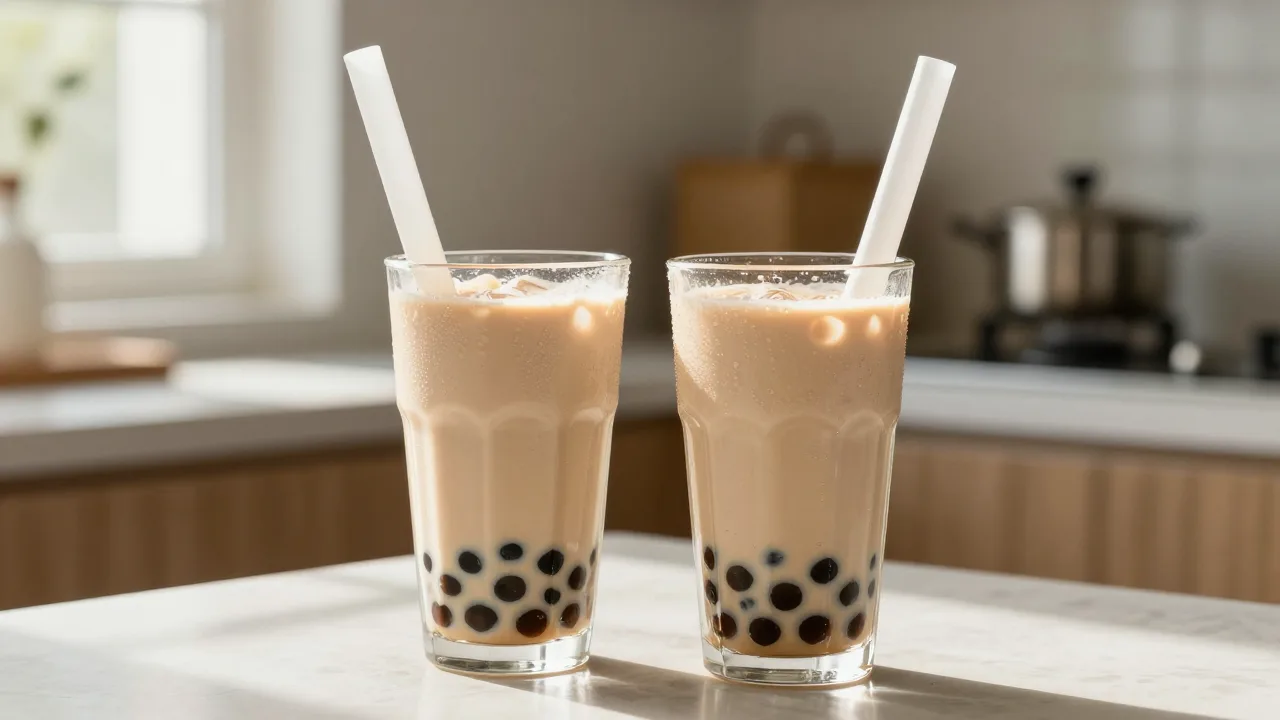
The first homemade bubble tea usually goes wrong in the last thirty seconds. The pearls came out chewy, the brown sugar syrup smells right, the milk tea is properly cold — and then everything gets poured into whatever tall glass was in the cabinet. There is no room for ice. The straw from the takeout drawer jams on the second pull. Half the pearls stay welded to the bottom because the glass is too narrow to swirl. You end up drinking around the problem instead of enjoying the drink you spent forty minutes making.
What makes this especially annoying is that the fix costs about twelve dollars and nobody mentions it in the recipes. Boba is not a drink you pour, it is a drink you assemble, and assembly needs volume, mouth width, and straw clearance that ordinary drinkware simply does not have. A shop cup looks oversized until you realize that a third of it is displaced by pearls and ice before any tea goes in.
So here is the practical version: what a boba cup actually has to do, which vessels do it well, and how to size the cup to your recipe instead of hoping.
The Five Things a Boba Cup Has to Get Right
- Volume, and more than you think. A standard serving of cooked pearls is around a third of a cup, displacing roughly 3 ounces. Add 6 to 8 ounces of ice and 10 to 12 ounces of tea and milk and you are already at 20 ounces with nothing left over. Twenty-four ounces is the comfortable number.
- Mouth width. You need to spoon pearls in, drop ice in, and stir or shake without splashing. Anything under about 70 millimeters across turns pearl-loading into a careful surgical operation.
- Straw clearance. The lid or opening has to take a 10 to 12 millimeter straw. Molded sipper lids and narrow spouts are non-starters.
- A flat, generous base. Pearls settle. A wide flat bottom keeps them in a loose layer you can pull from; a narrow tapered base packs them into a plug the straw cannot break up.
- Cold retention or visibility — pick one. You cannot fully have both. This is the real decision, and it splits the whole category in two.
The Contenders
Tall Clear Glass Tumblers
The purist's choice and the closest match to what a shop hands you. Glass shows the layers, imparts no flavor, and rinses clean of tapioca starch better than plastic. Look for straight-sided tumblers in the 20 to 24 ounce range with a flat base. The downsides are weight, breakability, and zero insulation — expect noticeable dilution within about forty minutes on a warm day. Borosilicate versions handle a hot tea base without the thermal-shock risk of ordinary soda-lime glass, which matters if you ever pour warm tea over ice in the same vessel. Our explainer on what borosilicate glass is covers why that difference is real rather than marketing.
Reusable Plastic Boba Cups With Sealing Lids
Purpose-built and genuinely the best value in the category. These are usually Tritan or PP, 24 to 32 ounces, with a wide screw lid, a silicone gasket, and a plug-sealed straw port sized for a boba straw. Most sets ship with a wide straw and a cleaning brush. They are light, hard to break, and the only clear option you can actually carry in a bag without leaking. The trade-offs: plastic scratches over time and eventually holds a faint scent from strong fruit teas, and clarity dulls after a year of dishwashing.
Double-Wall Borosilicate Glass
The compromise choice, and an underrated one. Two glass walls with an air gap keep your hand off the cold surface, slow melting versus single-wall glass, and eliminate the condensation ring on the table — while still showing the pearls. They are lighter than they look and surprisingly durable for their thinness, though a knock against the tap can end one. If the aesthetic is a large part of why you make boba at home, this is the cup that photographs best. We go deeper on the construction in our look at double-wall glass cup benefits.
Vacuum-Insulated Stainless Tumblers
The right answer if the drink has to survive a commute, a beach, or three hours at a desk. A vacuum tumbler keeps ice intact for many hours and the outside never sweats. What you give up is the entire visual experience, plus the ability to see how many pearls are left. Choose a wide-mouth model — some tapered tumblers are surprisingly awkward to load pearls into — and confirm the lid takes a wide straw before buying, since many straw lids are sized for standard straws only.
Wide-Mouth Mason Jars
The budget hack, and it works better than it has any right to. A 24-ounce wide-mouth jar has the volume, the flat base, and a mouth wide enough to load pearls by the spoonful. Straw-hole lids are sold cheaply. The limitations are honest ones: it is heavy, the threads collect syrup, and it looks like a mason jar rather than a bubble tea.
Home Sealing-Machine Cups
If you have gone far enough down this road to buy a cup sealer, the disposable PP cups and film rolls give you a genuinely spill-proof drink you pierce with a straw, exactly like a shop. It is the most authentic option and the least sustainable one. Reasonable for a party, hard to justify for a daily habit.
Side by Side
| Cup type | Best size | Shows layers | Ice retention | Portable | Rough price |
|---|---|---|---|---|---|
| Clear glass tumbler | 24 oz | Yes | Poor | No | $8–$18 |
| Reusable plastic boba cup | 24–32 oz | Yes | Fair | Yes | $10–$20 |
| Double-wall borosilicate | 16–20 oz | Yes | Good | No | $15–$30 |
| Vacuum stainless tumbler | 24–30 oz | No | Excellent | Yes | $25–$45 |
| Wide-mouth mason jar | 24 oz | Yes | Poor | Barely | $3–$8 |
| Sealed disposable cup | 16–24 oz | Yes | Poor | Yes | Per-use |
Kitchen Test: Six Cups, One Recipe, Ninety Minutes
Illustrative scenario — a composite example built to show how the numbers work. It does not describe a real business or customer.
We made a single batch of brown sugar milk tea — 3 ounces of cooked pearls, 7 ounces of ice, and 11 ounces of tea and milk per serving, about 21 ounces total — and split it across six vessels on a 78°F kitchen counter. Two results stood out. First, volume was the binding constraint, not temperature: the 16-ounce glass and the 18-ounce tumbler both overflowed during assembly and had to be short-poured, which is the exact failure most home recipes produce. Second, at the 45-minute mark the single-wall glass had lost its ice entirely and read visibly diluted, the double-wall borosilicate still had ice and tasted correct, and the vacuum stainless was essentially unchanged — but by then we could not tell how many pearls remained without opening it. The reusable plastic boba cup finished as the best all-rounder: it took the full pour with headroom, sealed for a trip to the porch, and the wide screw mouth cleaned out in under a minute. The 24-ounce size did more for the drink than any other single variable.
Straws: The Part People Under-Buy
A boba straw is 10 to 12 millimeters in internal diameter, roughly twice a standard straw, because cooked tapioca runs 8 to 10 millimeters across. Options break down like this:
- Stainless steel. Durable and dishwasher-safe, but conducts cold sharply against teeth and can chip a tooth if you bite down. Silicone tips solve both.
- Glass. Tastes like nothing, shows blockages, and looks best. Buy borosilicate and accept that one will eventually break.
- Silicone. Soft, safe for kids, the most forgiving. Holds odors from strong fruit teas unless cleaned promptly.
- Reusable plastic. Cheapest, lightest, scratches and clouds over a year.
Whatever you choose, get the beveled tip — the angle-cut end scoops pearls off the bottom rather than pressing them flat — and get the long brush. Sugar residue inside a straw is where every off-smell in reusable drinkware begins, and the fix is thirty seconds of brushing, covered in more detail in our guide to cleaning reusable cups.
Sizing the Cup to Your Recipe
Work backward from displacement instead of guessing at a cup size:
- Pearls: a third of a cup cooked, about 3 ounces of volume. Cooked tapioca roughly doubles from dry, so 2 tablespoons dry lands near one serving.
- Ice: 6 to 8 ounces of volume for a properly cold drink. Less than that and you are drinking cool tea.
- Liquid: 10 to 12 ounces of tea plus milk for a standard serving.
- Headroom: 2 ounces if you shake or stir in the cup, which you should.
That totals 21 to 25 ounces, which is exactly why shops default to 500 and 700 milliliter cups and why a 16-ounce tumbler will always disappoint. If you also make thick blended drinks, the same displacement logic and wide-bore straw requirement apply, and we compare vessels for that in our roundup of the best cups for smoothies and shakes.
What to Skip
- Tapered or hourglass tumblers. Pearls jam in the narrow section and refuse to be stirred loose.
- Molded sipper lids. The strawless spout that replaced straws in many chains cannot pass a pearl. Not one.
- Cups under 20 ounces. You will short-pour every time and blame the recipe.
- Stemmed or footed glasses. Top-heavy the moment you add ice and pearls, and unpleasant to stir in.
- Narrow-neck bottles. Impossible to load and worse to clean once starch dries inside.
On material more broadly, the trade-offs between glass, ceramic, and steel run through every drinkware decision, not just this one — our comparison of glass versus ceramic versus stainless is the short version.
If You Are Thinking Beyond the Kitchen
Plenty of people arrive at homemade boba by way of an idea for a small shop, and the cup that works for one drink at a counter is a different problem from the cup that works for four hundred. At volume the questions become sealing machines versus press lids, cup SKU counts, straw sourcing, and how fast a station can assemble a drink at peak. If that is where your curiosity is heading, this walkthrough of running a bubble tea shop's point of sale covers the ordering and throughput side, and there is a broader overview of the bubble tea business as a category worth reading before signing a lease.
The Bottom Line
Homemade boba fails on hardware more often than on technique. Get a cup that holds 24 ounces, opens wide enough to spoon pearls into, sits flat so the pearls spread out, and accepts a 12 millimeter straw — and most of the frustration disappears at once. Choose clear glass or a double-wall borosilicate if the look is part of the pleasure, a reusable plastic boba cup if you want one vessel that does everything, and a vacuum stainless tumbler only when the drink has to travel. Then buy the beveled straw and the brush. That is the whole equipment list, and it costs less than three drinks from a shop.
Keep Comparing Drinkware
Use the iCup library to compare materials, lids, cleaning routines, heat retention, glass shapes, and daily-use tradeoffs before buying another cup.
Explore More iCup Guides →