Branded Drinkware for Small Businesses
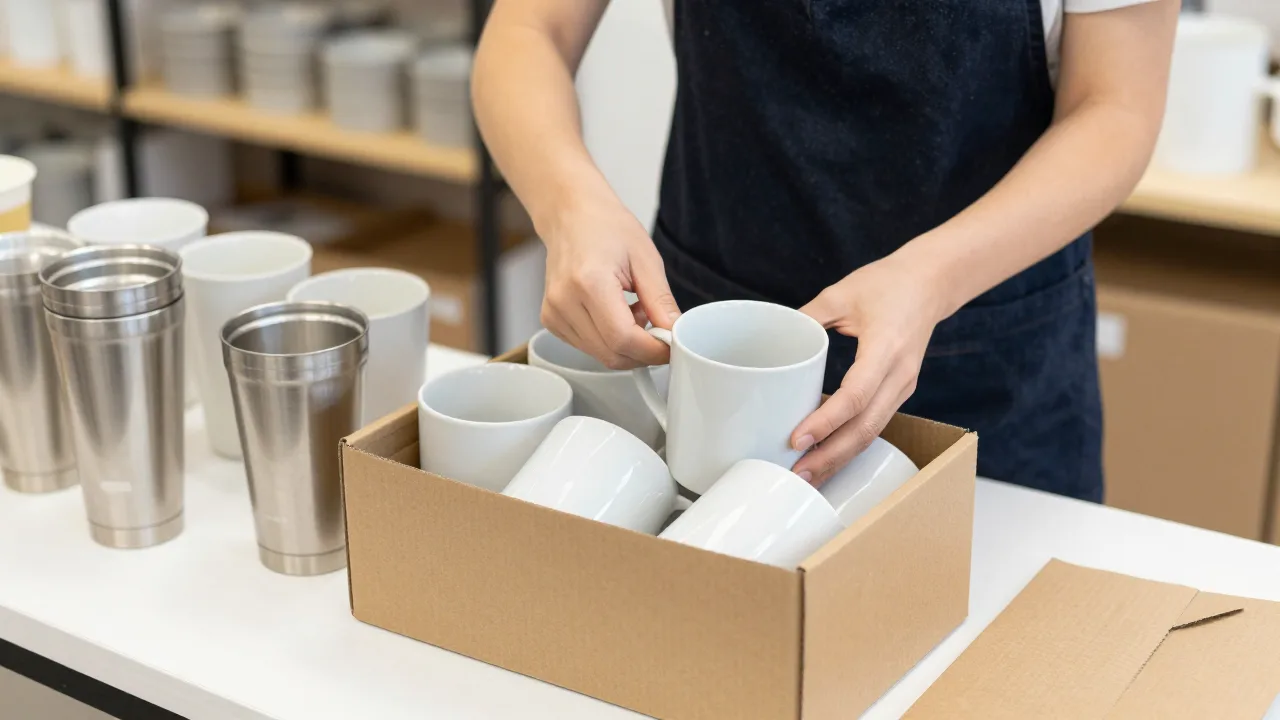
Almost every small business owner who has ordered branded drinkware can tell the same story. A supplier quoted $5.80 each at 100 units and $3.90 each at 500, the savings looked obvious, and the truck arrived with more mugs than the business could realistically move in three years. Two years later they are still stacked in the back, a few given away at a street fair, the rest quietly becoming furniture.
The failure was never the mug. It was that nobody decided what the mug was for before ordering it. Branded drinkware can be three completely different investments — an advertising medium, a margin product, or an operational tool — and each one has different math, a different quality bar, and a different right quantity. Mix them up and you buy giveaway-grade ceramics and try to sell them at $18, or buy premium tumblers and hand them out with no way to know whether it worked.
Here is the version that keeps the closet empty: what these things really cost, which decoration methods survive real use, and how to pick a quantity you can actually clear.
Step One: Pick One Job
Before any quote, decide which of these three the order is. Not two of them. One.
- Giveaway and gifts. This is advertising. Success is measured in impressions and recall, and the correct metric is cost per impression. A cup that lives on a customer's desk beats a flyer by an enormous margin because it is seen for years, not seconds.
- Retail merchandise. This is a product line. Success is measured in sell-through rate and gross margin per unit. It only works when customers actually want to display your name, which is a real bar most businesses clear only after building a genuine local following.
- Staff and operations. This is equipment. Branded tumblers for the team cut single-use cup costs, look consistent on the floor, and solve the "whose mug is this" problem. Quality matters more than beauty, and quantity is simply headcount plus a margin for loss.
Businesses that name the job before shopping tend to order roughly a quarter of what businesses that skip the step order — and they use all of it.
What It Actually Costs
Prices vary by supplier, region, and season, but the structure is consistent: a blank cost, a one-time setup charge, and a per-piece decoration charge. Here are realistic ranges at small-business quantities:
| Item | Blank cost | Decoration method | Setup | Per-piece decoration | Typical MOQ |
|---|---|---|---|---|---|
| 12 oz ceramic mug | $2.20–$3.50 | Screen print, 1 color | $40–$75 | $0.60–$1.20 | 36–72 |
| 12 oz ceramic mug | $2.80–$4.20 | Sublimation, full color | $0–$40 | $1.50–$3.00 | 12–36 |
| 20 oz stainless tumbler | $6.00–$11.00 | Laser engraving | $40–$60 | $1.50–$3.00 | 24–50 |
| 20 oz stainless tumbler | $6.00–$11.00 | UV digital, full color | $50–$90 | $2.00–$4.50 | 24–50 |
| 16 oz reusable plastic cup | $1.20–$2.40 | Pad print, 1–2 colors | $45–$80 | $0.45–$0.90 | 100–250 |
| Glass pint or tumbler | $2.00–$4.00 | Sandblast or fired decal | $50–$90 | $1.00–$2.50 | 72–144 |
Add shipping — drinkware is heavy, and freight on a few hundred ceramic mugs is not a rounding error — plus roughly 2 to 5 percent breakage on ceramic and glass. A useful mental shortcut: a finished branded mug lands near $5, a finished branded tumbler near $12. If a quote is far under that, look closely at the blank.
Decoration Methods and What Survives
The decoration decision determines whether the cup still looks good in year two, and it is where most disappointment originates. A print that peels after twenty dishwasher cycles turns your logo into a cautionary tale sitting on someone's shelf.
- Laser engraving (metal). Ablates the coating or etches the steel. Nothing sits on the surface, so nothing can peel. Single color — the natural metal beneath — but it is the most durable option available and reads as premium.
- Fired ceramic decal or fired screen print. Ink fused in a kiln at high temperature. Genuinely permanent, full color possible, and the standard for mugs meant to be kept.
- Sublimation. Dye gassed into a polymer coating. Excellent full-color reproduction and strong durability on properly coated mugs. On powder-coated tumblers it looks superb but is more vulnerable to scratches and dishwasher heat.
- UV digital printing. Photographic detail, no color limits, low setup. The ink cures on the surface, so it is the least abrasion-resistant of the good methods. Hand-wash guidance is not optional here.
- Pad and screen printing. The workhorse for volume. Cheap per piece, limited to solid spot colors, and durability depends entirely on whether the ink is cured properly.
- Vinyl decals. Fast and cheap for tiny runs. They will peel. Fine for a one-day event, wrong for anything a customer keeps.
If you are weighing methods for mugs specifically, we compare the processes side by side in custom mug printing methods compared, and the small-batch and one-off approaches are covered in our DIY custom mug guide.
The Cost-Per-Impression Math
For giveaways, the number that matters is not what the mug cost — it is what each exposure cost. Run it honestly:
A $5 branded mug that a customer keeps on their desk and uses three times a week for two years produces roughly 300 direct uses, plus incidental views by coworkers and family. Call it 300 impressions conservatively. That is about 1.7 cents per impression, and every one of those impressions happens in a moment of small pleasure rather than interruption. Compare that to almost any paid channel and the mug looks excellent.
But the calculation collapses if the mug is ugly, cheap-feeling, or covered in a logo so large that nobody wants it visible. An unused mug in a cabinet is worth zero impressions at $5 apiece. Which produces the single most counterintuitive rule in branded merchandise: make the logo smaller. A tasteful mark on a genuinely nice cup gets used daily. A billboard on a thin ceramic gets buried behind the cereal bowls.
The same logic that governs physical, always-visible marketing applies here — it is closer to the economics of yard signs and other physical local marketing than to a digital campaign: low unit cost, long dwell time, and value that compounds only if the thing looks good enough to keep out.
What a 60-Unit First Order Taught One Café
Illustrative scenario — a composite example built to show how the numbers work. It does not describe a real business or customer.
A neighborhood coffee bar wanted merchandise but had been burned before by a 250-piece t-shirt order. This time they ordered the supplier's minimum: 36 laser-engraved 20-ounce tumblers at $11.40 landed and 24 fired-decal 12-ounce mugs at $5.10 landed — about $533 total, small enough to write off if it failed.
They priced the tumbler at $28 and the mug at $14, and paired the tumbler with a standing $2 refill discount, so a regular buyer breaks even after fourteen visits. The tumblers sold out in five weeks; the mugs took four months. Gross profit on the run was roughly $760, but the more valuable output was the information. The tumbler sold because it was useful and the discount made it a rational purchase, not a loyalty gesture. The mug sold slowly because customers who wanted a mug at home already owned six.
The reorder reflected that: 100 tumblers, zero mugs, and a small run of engraved insulated bottles for staff. The rule they landed on — buy the minimum, learn from sell-through, then scale the winner — is the entire lesson, and it cost them $533 to buy instead of $4,000.
Quantity: Where Programs Actually Die
Volume pricing is designed to make you over-order, and it works. Here is the discipline that beats it:
- Order the minimum on the first run. Always. The per-unit price at 500 is irrelevant if you sell 60 a year.
- Set a ninety-day sell-through target. If clearing the run in three months does not sound plausible, the run is too big.
- Split across designs sparingly. Two colorways of one tumbler beats one each of four products, because you learn something clean about demand.
- Keep the artwork reorderable. Setup charges are one-time with most suppliers if they keep your screens or files. Confirm that in writing before the first order, since it changes the reorder economics substantially.
- Budget for staff and comps. Roughly 10 to 15 percent of any run disappears into team cups, gifts, photos, and giveaways. Plan for it instead of discovering it.
Design Rules That Survive Real Use
- One color, high contrast. It costs less, prints more reliably, and ages better than a gradient.
- Small mark, good placement. A logo roughly 2 to 3 inches wide, positioned opposite the handle, is the sweet spot for ceramic.
- No fine detail under 1 point. Hairlines fill in on screen printing and disappear entirely in engraving.
- Leave the wash zone alone. Keep artwork off the rim and off the base where abrasion is worst.
- Consider something other than the logo. A neighborhood name, a local landmark, an inside joke your regulars share — these get used far more often than a plain wordmark. You are competing for cabinet space against every mug the customer already owns, and the ones that stay in rotation usually mean something, a pattern our piece on collectible mugs traces over decades.
- Print care instructions on the tag. Hand-wash guidance costs nothing and prevents the failure that damages your brand.
Pricing Merchandise
Standard practice is 2.2 to 2.5 times landed cost. A tumbler at $12 delivered prices at $27 to $30; a mug at $5 prices at $12 to $16. Two adjustments matter more than the multiplier:
First, price against what customers already know. A logo tumbler at a premium price needs a blank that feels comparable to respected insulated brands. Second, decide whether the item is a keepsake, a staff cup, or a refill program; those three jobs need different quantities, margins, and durability standards.
One more option worth considering for businesses with a craft-forward identity: small-batch local production. Working with a nearby ceramicist costs more per unit and yields a product that reads as genuinely special rather than promotional — the trade-offs are covered in our guide to handmade ceramic cups.
The Five Ways These Programs Fail
- Over-ordering for a volume discount. The single most common and most expensive mistake.
- Choosing the cheapest blank. A thin, light mug feels bad in the hand, and people do not keep cups that feel bad.
- Oversized logos. Turns a gift into an advertisement the recipient has to justify displaying.
- Wrong decoration for the use case. Vinyl on something meant to last, UV print on something headed for a commercial dishwasher.
- No distribution plan. Cups do not sell from a closet. Decide before ordering exactly where they sit, who mentions them, and what triggers a customer to pick one up.
The Bottom Line
Branded drinkware is one of the few marketing spends that a customer will voluntarily keep in their kitchen for years — but only if you treat it as a real product rather than a leftover budget item. Decide whether the cup is advertising, merchandise, or equipment. Pay for a blank that feels good in the hand and a decoration method that outlives the dishwasher. Order the minimum, watch what actually sells, then scale the winner. Do that and the math works comfortably at under two cents an impression. Skip it and you have bought yourself a very expensive shelf.
Keep Comparing Drinkware
Use the iCup library to compare materials, lids, cleaning routines, heat retention, glass shapes, and daily-use tradeoffs before buying another cup.
Explore More iCup Guides →